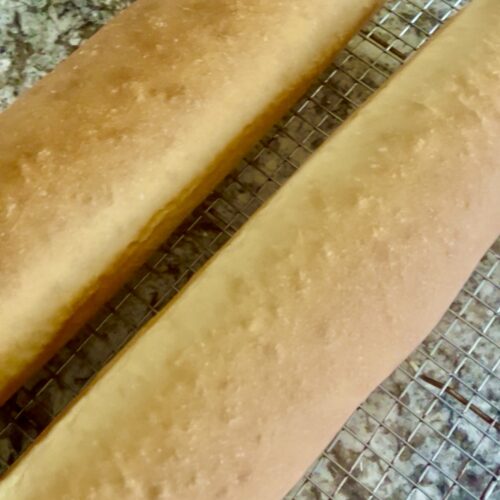
Pan Sobao-Puerto Rican Bread
A delicious, soft and slightly sweet bread that you won't regret making.
Equipment
- 1 18x13 cookie sheet pan prep parchment paper or silicone mat
Ingredients
Poolish
- 120 g bread Flour
- 120 g water- room temperature
- 1/8 tsp instant yeast
Bread Dough
- 495 g bread Flour
- 4.5 tsp instant yeast
- 1/4 cup granulated sugar
- 50 g (3.5 tbsp) Shortening or Lard or olive oil or melted butter choose one
- 230 g water-room temperature
- 1.5-2 tsp salt
- prepared poolish
Instructions
- Prepare poolish by mixing all ingredients in a medium bowl. Mix will look shaggy. Cover the bowl and let it stand at room temperature for 8 hours. After 8 hours, refrigerate the bowl for for a few hours, until ready to bake. Do not exceed 24 hours. Mix will look bubbly and hydrated.
- When ready to bake, take out the poolish from refrigerator and let it warm up at room temperature, for about 30 minutes, while you gather the rest of the ingredients to bake your pan sobao.
- Prepare a large baking pan. I use silicone mat but you can use parchment paper.
- In a bowl of a stand mixer or bread dough mixer or just a regular large bowl, add your flour, instant yeast, sugar, fat you are using, water, salt and the prepared poolish
- knead the ingredients for 10-15 minutes, or mix the ingredients and then knead with your hands. Depending on what keading method you are using. Check that the dough is clearing up the sides of the bowl, like you see in the video I posted. If you notice that too much dough is sticking to the sides of the bowl, scrape the dough from the sides and add 2 -4 tbsp of bread flour and this should clear up the sides. If not, if to much dough is sticking, add a bit more flour but try not to add much more. Final dough should not stick to your hands. It should be smooth and stretchy.
- Once the dough is kneaded, form a ball, oil the dough ball with a bit of oil and bring it back to the bowl that you used for mixing or kneading, cover it and let it rise for about 90 -120 minutes, or until it doubles in size.
- Once the rising is done and the dough has doubled in size, flour your counter top a bit and your hands, and punch down on the dough to deflate it. Invert the bowl with the dough on your countertop, and flatten the dough a bit with your hands.
- Divide the dough into roughly two equal parts. Flatten each section with your hands and then fold, like you are folding an envelope, Please watch video so that this can be more clear. Cover the two doughs for 10 minutes. This resting of the dough makes the final shaping easier.
- After 10 miutes, begin to shape the doughs into loaves. Take one dough and roll it with a rolling pin or your hands, into a rectangle that is roughyl 16x5 or 17x5
- roll the length of the rectangle, facing you, into a long log and pinch the seams. Once the seams are pinched, roll the log gently to ensure that the seams close and make the loaf more uniform in shape.
- Place loaf log on prepared pan
- Repeat process with other dough and add to the pan that you are using to bake the breads
- Cover the pan with a large towel and let the loaves have their final rise for 30 minutes to an hour.
- Take this time to preheat your oven to 400 degrees and add that pan that you are using to heat up, to create steam. I use a small 6 inch cast iron skillet.
- When the loaves get puffy, brush or spray them with water and place inside your oven's middle leveled rack.
- Once pan with loaves is inside oven, go ahead and add 1 cup of ice or hot water to the small cast iron skillet. This should create a rise of steam, immediately close the oven door to trap steam inside.
- Bake pan sobao for 15-20 minutes or until it's a deep golden color.
- Once done, let the loaves stay in the pan for 5 minutes and after 5 minutes, move them to a cooling rack. Cool completely before cutting.
Video
Notes
- The poolish is totally optional so that if you are not using, just add all of the ingredients, including the ingredients under the poolish, to your dough, without taking steps to ferment to create a poolish. Just add and mix/knead.
- I highly recommend that you do take the time to create a poolish, when you are able too. It really does make a difference in the final product.
- The fat that you use is up to you. In Puerto Rico, they use lard or shortening.
- The amount of sugar that I use makes the sweetness detectable in this recipe but not overwhelming. Increase to 1/3 cup for a sweeter bread.